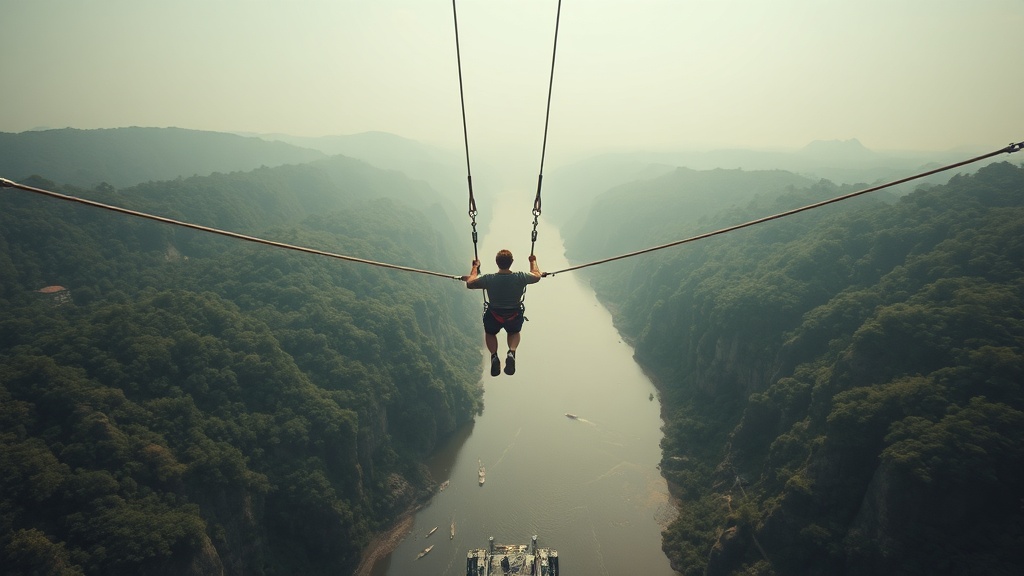
Common Bungee Jumping Accidents and How They're Prevented

Bungee jumping relies on the illusion of extreme danger. The massive height, the howling wind, and the primal fear of falling all convince your brain that you are about to die. That's what makes the adrenaline rush so addictive.
But as a jump master with over 400 jumps globally and a home base at the Nevis Bungy, I deal in reality, not illusions. And the reality is that when bungee jumping is done correctly, it is incredibly safe. However, accidents have happened historically, and understanding why they happened is the key to understanding how modern operators ensure they never happen again.
Here is the unfiltered breakdown of common bungee jumping accidents of the past and the bulletproof protocols we use today to prevent them.
What Causes Cord Failures and How Are They Prevented?
The absolute worst nightmare for any jumper is the idea of the bungee cord snapping. While exceedingly rare in modern commercial jumping, cord failures in the early, unregulated days of the sport usually came down to two things: poor materials and exceeding the cord's lifespan.
How Do Modern Operators Prevent Cord Snaps?
Historically, some rogue operators used inferior rubber or failed to track how many times a cord was used. Latex degrades with every stretch and with exposure to UV light.
Today, reputable operators—especially those following strict guidelines like the Adventure Activities Regulations in New Zealand—use highly engineered, multi-strand latex cords. This multi-strand design means that even if a few internal strands break, the cord itself will not fail catastrophically.
More importantly, we operate on a strict, non-negotiable jump-limit protocol. Every single jump is logged. Once a cord reaches its maximum allowable jumps (often a few hundred), it is retired and physically destroyed, regardless of whether it looks brand new. We never push a cord past its documented lifespan.
How Are Miscalculated Drops Prevented?
Another historical risk was jumpers hitting the water too hard or hitting the ground beneath them because the cord stretched further than anticipated.
Why Is Precise Weighing Non-Negotiable?
Miscalculated drops happen when the operator gets the jumper's weight wrong or uses the wrong cord for that weight class. A heavier jumper on a cord meant for a lighter person will cause the cord to over-extend.
This is why, at any professional site, you are weighed on calibrated scales. You are never asked to guess your weight. The jump master takes your exact weight and cross-references it with strictly defined charts to select the precise cord tension and adjust the static line length. The math is calculated so perfectly that at sites like the Kawarau Bridge, we can adjust the setup to let you touch the water with exactly your fingertips, your waist, or not at all.
How Do We Prevent Harness Slippage?
The idea of slipping out of the ankle bindings mid-air is terrifying, and it has caused serious accidents at unregulated sites globally.
Why is the Dual-Harness System Mandatory?
If an operator only ties you by the ankles, they are incompetent. Modern commercial bungee jumping demands a redundant attachment system.
When you jump with us, you wear a highly secure ankle wrap. But that is only your primary attachment. You also wear a full-body or waist harness. A completely separate backup line connects the bungee system to this waist harness. If, in a one-in-a-million scenario, your feet were to slip free from the bindings, you would instantly be caught safely by your waist harness. You are always tethered to the lifeline in at least two independent ways.
How Does Human Error Cause Accidents and How Is It Mitigated?
In almost every complex system, the weakest link is the human running it. Rushing, distraction, or complacency can lead to unclipped carabiners or tangled lines.
What is the "Dual-Check" Protocol?
We do not rely on one person to get everything right 100% of the time. We mitigate human error through forced redundancy.
Every jumper goes through a dual-check protocol. Jump Master A will put your harness on, attach the lines, and lock the carabiners. Before you are allowed anywhere near the edge, Jump Master B—who was not involved in gearing you up—will step in. They will physically touch, tug, and visually verify every single connection point, buckle, and lock. Only when Jump Master B clears you are you allowed to jump. This eliminates the risk of a single tired or distracted employee making a fatal mistake.
The Takeaway
When you hear about bungee jumping accidents in the news, they almost universally occur at unregulated, fly-by-night operations that ignore the established global safety standards.
When you jump with a world-class operator, you aren't just trusting a rubber band; you are trusting decades of engineering, rigorous redundancy, and obsessive safety protocols designed specifically to counteract human error and mechanical failure. We obsess over the worst-case scenarios so that when you step to the edge, all you have to do is focus on the rush.
If you are curious about the equipment we use to capture these safe jumps, read my guide on the GoPro Hero 12 for bungee setups.