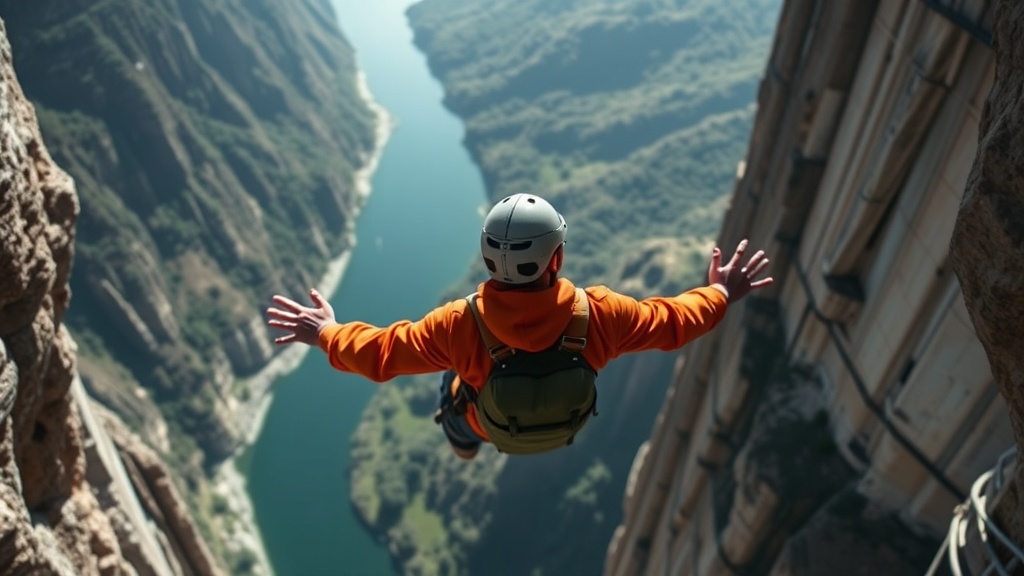
Why Your First Bungee Jump Feels Nothing Like You'd Expect

The human body reaches terminal velocity in a bungee jump at roughly 120 kilometers per hour—and yet, according to a 2019 study published in the Journal of Applied Physiology, your brain perceives that four-second freefall as lasting nearly three times longer than it actually does. Time dilation isn't just theoretical physics—it's the first thing that hits you when you step onto that platform. This guide breaks down what really happens during your inaugural leap, from the pre-jump jitters that still get me after 400+ jumps to the bizarre sensory cocktail that follows the rebound. Whether you're eyeing the Kawarau Gorge in New Zealand or the Verzasca Dam in Switzerland, understanding the mechanics of fear—and why it feels so good afterward—will transform how you approach the edge.
What Does Freefall Actually Feel Like?
Everyone asks this. Everyone expects the same answer: "Like flying!" It isn't. Flying implies control, and control is the first thing you surrender when you tip forward into nothing. What it actually feels like—what it felt like on my first jump at Victoria Falls and what it still feels like when I'm testing new setups—is closer to the sensation of missing a step in a dark staircase, except that step never comes.
Here's the physiological breakdown. Your vestibular system—the inner ear mechanism responsible for balance—sends panicked signals to your amygdala within the first half-second. Your heart rate spikes (mine hits 140 BPM before I even leave the platform), and adrenaline floods your bloodstream at concentrations comparable to a near-miss car accident. The difference? You're doing this deliberately. That intentionality matters. Research from the University of Queensland confirms that voluntary risk-taking triggers dopamine release in ways that involuntary stress simply doesn't. The jump isn't terrifying in retrospect—it's terrifying in anticipation, electric in execution, and euphoric in memory.
The rope catches you differently depending on your body position. Jump headfirst and you'll feel the deceleration through your chest—a gradual, almost elastic tug that builds rather than snaps. Jump in a swan dive and the G-force distributes across your torso. I've seen first-timers expect a jarring halt; instead, they describe the rebound as "bouncing on a giant trampoline made of air." That's the latex rubber doing its work—modern bungee cords stretch up to 300% of their resting length, converting your kinetic energy into potential energy and then back again. The physics are elegant. The sensation is primal.
Most people experience three distinct phases during the jump itself. Phase one is the drop—pure, thought-free acceleration where your internal monologue goes silent. Phase two is the stretch, where the cord engages and you feel that impossible slowing, like the universe hitting the brakes. Phase three is the rebound, where momentum carries you back up and suddenly you're looking at the platform from below, laughing or screaming or both. I've never seen anyone remain silent during phase three. Something breaks open in that upward arc.
How Safe Is Bungee Jumping in 2024?
The short answer: statistically safer than driving to the jump site. The longer answer involves understanding why accidents make headlines while millions of uneventful jumps don't.
Modern bungee operations are governed by rigorous standards that vary by jurisdiction but share common DNA. In New Zealand—where commercial bungee jumping was essentially invented—operators must comply with WorkSafe New Zealand adventure activity regulations, which mandate daily equipment inspections, annual third-party audits, and jump master certification programs that take months to complete. The cords themselves have finite lifespans—most operators retire them after 500-1000 jumps regardless of visible condition. Factor in backup systems, redundant harness attachments, and weight-specific cord selection, and you're looking at safety protocols that rival commercial aviation.
The real risks aren't equipment failures—they're medical disqualifications you might not know about. Retinal detachment, for instance, becomes a concern if you're severely nearsighted (myopia beyond -6.00 diopters). The rapid deceleration creates brief pressure spikes in the eye that healthy retinas handle fine but weakened ones might not. Pregnancy is an automatic no-go. Recent surgeries, uncontrolled epilepsy, and certain cardiovascular conditions also exclude you. Reputable operators will screen for these; sketchy ones won't. Your job is asking questions before you pay.
I've operated jumps in five countries, and the variance in regulatory stringency is real. European Union operators generally adhere to CEN safety standards for elastic devices, while some developing-world locations operate in regulatory gray zones. That doesn't make them dangerous—it means your due diligence matters more. Look for operators affiliated with major players like AJ Hackett or Interlaken's Outdoor Interlaken, which maintain internal standards that often exceed local requirements. Check recent reviews for mentions of equipment checks and safety briefings. If the platform feels sloppy, walk away. Your life is worth more than a refund.
Where Should You Jump First?
Location selection shapes your experience more than most first-timers realize. The height matters, yes—but so does the scenery, the water proximity, the platform type, and even the local jumping culture. After four hundred jumps across five continents, I've developed strong opinions about where beginners should start.
For the classic introduction, you can't beat New Zealand's Kawarau Bridge—the birthplace of commercial bungee. At 43 meters, it's substantial enough to feel legitimate without being overwhelming. The water below offers the option of a touch-and-release dip (operator's discretion based on river levels), and the surrounding canyon scenery is pure South Island drama. The operation there has been refined over three decades; they've seen every hesitation, every last-minute panic, every request for a countdown do-over. They know how to talk you off the ledge—metaphorically, since you'll be jumping from one.
If you want maximum visual impact, consider the Verzasca Dam in Switzerland. At 220 meters, it's among the world's highest commercial jumps, and the setting—concrete arch, turquoise reservoir, alpine peaks—feels almost cinematic. (James Bond agreed; they filmed the opening of GoldenEye there.) The trade-off is intensity. That height buys you nearly eight seconds of freefall—long enough for your brain to cycle through denial, panic, and strange acceptance before the cord engages. I don't recommend it for absolute beginners unless they've already acclimated to height through skydiving or similar.
For something different, try the Bloukrans Bridge in South Africa—the highest bridge jump on the continent at 216 meters. The setting is spectacular, spanning a gorge thick with indigenous forest. Or consider Macau Tower if you want urban vertigo; jumping from a building rather than natural terrain produces a distinct psychological effect. The city spreads beneath you like a circuit board, and the jump happens in weather-controlled conditions—no wind cancellations, no rain delays.
What to Look for in Any Jump Site
- Transparent safety records: Ask about incident history directly. Good operators answer openly.
- Platform construction: Fixed platforms feel more stable than temporary setups—especially for nervous jumpers.
- Weight accommodation: Most sites handle 35-150 kg, but extremes vary. Confirm your range before booking.
- Video packages: Most sites offer them; some include multiple angles. Worth the money for a first jump.
- Recovery procedure: How do you get down after the bounce? Some lower you gently; others winch you back up. Ask beforehand.
Preparing Your Body and Mind
The night before matters less than the hour before. I've watched athletes freeze and couch potatoes fly. Physical fitness helps—core strength stabilizes your body position, reducing the spinning that disorients some jumpers—but mental preparation dominates the experience.
Eat lightly. Not because you'll vomit (uncommon if you're healthy), but because a full stomach adds physical discomfort to psychological stress. Stay hydrated but don't chug water right before—you'll be harnessed for a while. Sleep helps; sleep deprivation amplifies anxiety and impairs decision-making. Don't drink alcohol beforehand—reputable operators will turn you away if they smell it, and for good reason. Alcohol disinhibits the wrong impulses and masks symptoms that might indicate a medical issue.
The mental game is where this gets interesting. I still get nervous on platforms. Not shaking, not paralyzed—just that elevated heart rate, that slight sweat, that awareness of consequence. I've come to trust that nervousness. It's information, not instruction. Your body is preparing for something significant; let it. The mistake is interpreting that arousal as a signal not to jump. Elite athletes call this arousal reappraisal—reframing physiological stress as readiness rather than danger. It works.
On the platform, breathe. Deep, slow exhales activate the parasympathetic nervous system, countering the adrenaline surge. Don't overthink your technique—the jump master handles the details. Your only job is stepping off. I tell nervous first-timers to focus on their feet, not the view. Look down, acknowledge the height, then fix your eyes on a point straight ahead. When they count down, don't anticipate. Just let go on "one." The moment you decide is the moment before you regret. Hesitation magnifies fear; commitment dissolves it.
After the jump—after the rebound, after the lowering or winching up, after your legs touch solid ground again—you'll feel it. That euphoric wash, the unstoppable grin, the urge to immediately do it again or never do it again (both are valid responses). Your brain is processing the survival of a perceived threat, and it's rewarding you with neurochemical gold. Savor it. Document it. And start planning the next one—because the first jump rewires something, and that something usually wants more.